Showing posts with label you might not know. Show all posts

Friday, January 6, 2012

Mandatory Driver Education

.

As a friend drove me somewhere the other day, I noticed that she didn't know how to drive properly. This person used to be an accident investigator for the US Postal Service; she knew just about everything there was to know about trucks without having driven one, and yet, she was driving very discourteously around them as well as other cars. I was surprised to see her blocking up traffic, riding bumpers, riding catacorner to people in their blind spots at highway speeds (what I call "clipping"), and using an inconsistent speed which meant she got in everyone's way.

Of course, she's hardly the only offender. I constantly see people driving like they're idiots, getting in my way, and otherwise flirting with disaster. Thank God I'm a better driver than almost anyone! I have evaded being in several accidents in the past 20-some years since I've had a license, and so I thought I'd offer a few driving tips so you can learn them and then lord them over your buddies the way kids nag their parents to wear their seatbelts.

After I castigated her, I wrote these 8 Simple Rules for Driving on my Road:


Rule #1: If you want to drive faster than me, please do it BEFORE I pass you, not during and not after.

Rule #2: If you want to pass me, please continue to drive faster than me. I don't want you flying past me, then getting in front of me and slowing down, then speeding up again when I move over to pass you. Cruise control is your friend.

Rule #3: Never, ever sit next to another vehicle for longer than 5-10 seconds. If that means you have to speed up to pass them, do it! Sitting next to someone, especially a big truck, is inviting disaster and it's damned rude to do, nevermind that you're blocking traffic.

Rule #4: If you're not turning or changing lanes, turn your turn signal off. And if you are going to turn or change lanes in dense traffic, turn it on!

Rule #5: Turn your stupid radio down! No one wants to hear it. Especially at the gas station, where we're afraid the pounding is going to damage the underground gasoline tanks and set off an explosion.

Rule #6: When you're trying to get on the highway, you have my permission to use the entire length of the ramp and the acceleration lane to get up to speed and merge safely. It is no longer required that you either merge into the highway at 30 below the speed limit and then speed up, or come to a stop at the intersection and wait for three miles of clear before you merge. (Unless you live in Pennsylvania.)

Rule #7: When you're trying to get off the highway, it is not necessary to whiz past me and get off at the last possible second, nearly knocking me off the road just because you felt you had to get in front of me. Just slow down, wait that one extra second, and then get in the deceleration lane from behind me. There is no prize for getting to the road before I pass under the bridge.

Rule #8: Do NOT put on makeup while you are driving, ladies! Especially do not use that eyeliner pencil which WILL poke your eye out if you hit a crack in the road. When you're at a light, I'll tolerate it, as long as I'm not stuck behind you when the light turns green. (This means you, Jenny!)

That's it. Do those simple little things and you will cause and be in fewer accidents, and you will also save yourself and everyone around you a lot of unneeded stress and even a little cash on your gasoline bill.

What rules of the road would you like to see?

.

Wednesday, October 19, 2011

Road trip 2 - A Moment of Silence for those We've Lost

Location: 620 N Harvey Ave, Oklahoma City, OK 73102, USA
.

Not counting the 9/11 World Trade Center attacks, what is the worst act of terrorism committed within American borders? Maybe Waco comes to mind. Or the 1993 World Trade Center bombing. Or the DC sniper. Those were terrible events, but the Oklahoma City bombing, which took place in 1995, is what I'm talking about.

As a truck driver, I've been through OKC many times, and been across the state of Oklahoma even more. The roads through the state are designed such that you almost can't pass through Oklahoma without also going through its capital.

There's a lot to see in these pictures; take your time as you look at them.
On the morning of April 19, 1995, a pair of soulless men filled a truck with fertilizer and other explosives. One of them drove it to the front of the Murrah Federal Building, a nine-story multipurpose high rise in the heart of the city. He parked the van, fuses already lit, and walked away. A few minutes later, at 9:02 AM, a large explosion devestated the building and the parking lot across the street. At least 168 people died, including 19 children in the daycare center, and 680 more were injured. Within a 16 block radius, 324 buildings were damaged and 86 cars were destroyed. The bomb had to be enormous to cause so much damage; it was equivalent to 5000 pounds of TNT, or 1/4 the power of the atomic bomb dropped on Hiroshima.


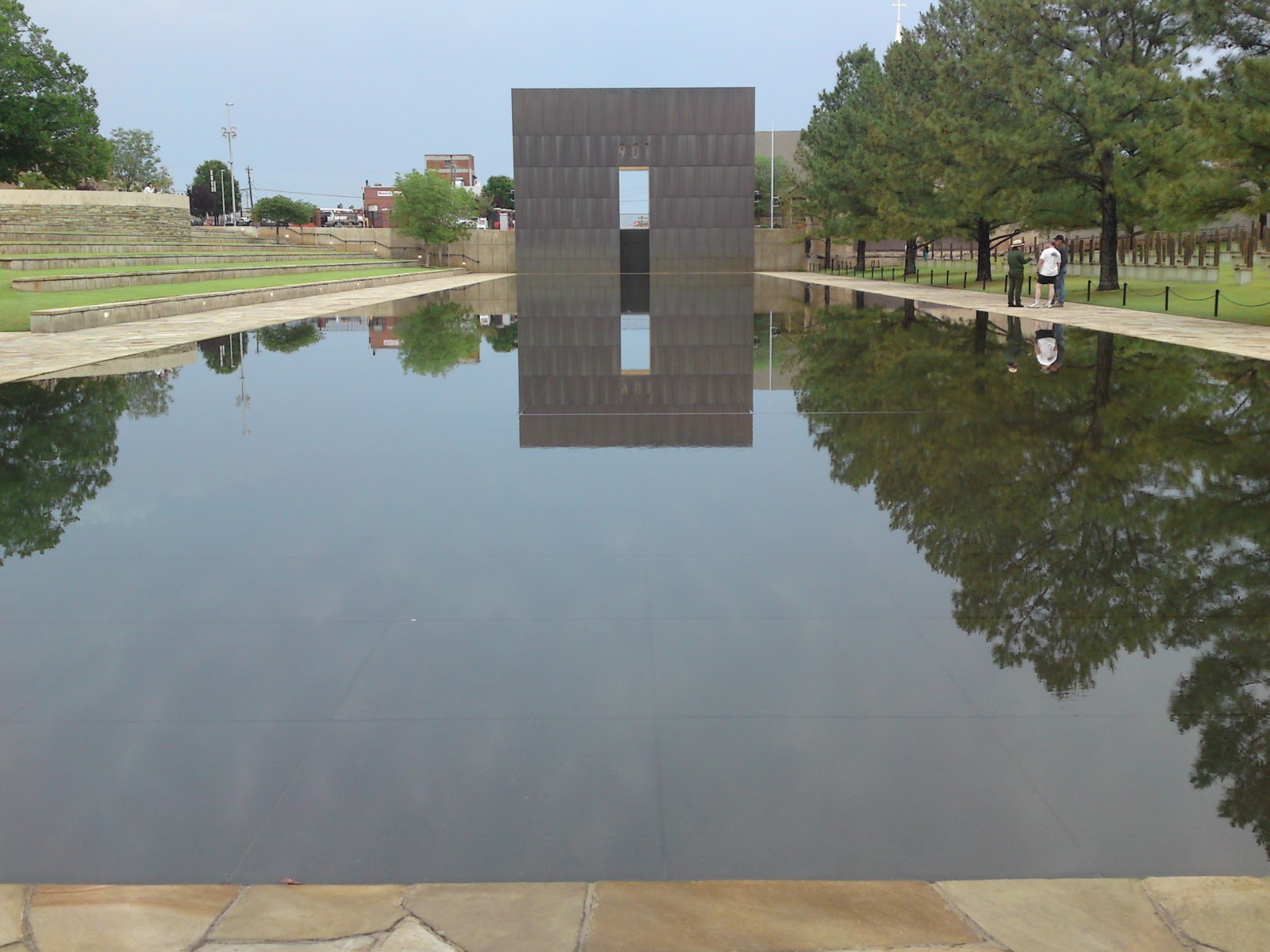
After clearing away the rubble, a memorial park was created, encompassing the entire area around the blast and the former location of the building. As you drive down the street, it suddenly ends at a park. There used to be a street there, but it's now a reflecting pool. On one side, where the Murrah building was, is arrayed 168 chairs, most of them adult-sized, but many of them much smaller. There is a chair for every person who died that day. The small chairs are for the children who perished.


To read that here might not impact you much, but to see it up close is powerful. It really moved me, brought the event home for me. Before that moment, it was some distant thing that happened to someone who may as well have been in another country. When it happened, I'd never been anywhere near Oklahoma and had only nominal ambition ever to go. But after that moment, I really wanted to stay there for a while, read everything there was to read, see the memorial museum, and learn the story behind not just the attack, but also the rebuilding and the people whose lives were impacted by it all.


Unfortunately, we didn't get there until late. The park itself is open 24 hours, but the museum closes at 6:00, and we were a few minutes too late, after having driven all the way from Jackson. I would've liked to come back in the morning, but we had to get to Colorado Springs the next day, which I'll tell you about next week.

In the meantime, I've posted several additional pictures of my time at the Oklahoma City National Memorial on the More in Sanity Facebook page.

Lots more coming up; see you again soon!

_______

Last Week's Installment: Road trip 1 - Who Shot JR

.

Monday, September 13, 2010

"The The Impotence of Proofreading," by TAYLOR MALI

.

"The The Impotence of Proofreading," by TAYLOR MALI

This is a short video presentation. It's pretty funny, but technically I wouldn't term it as safe for work.

Reminds me of a couple years ago, back when I frequented forums a lot more than I do now, when I got tired of all the horribly misspelled posts I had to read to get to an idea. I finally created a short saying that summed up my feelings pretty well. Then some over-sensative idjit said I was being "offensive". Here's the full text of what I was trying to say:

"If reeding you're techs tis all-most tore-chore fore pea-pull, pleas bee shore two ewes thee rye-towards too right hear inn thee four-umms; its aweigh too lettuce no ewer knot uh more-ron. It snot sew vary harred two due atoll. Thang-queue."

I'm so bad, as my friend Natalie will tell you.

It also inspired the You Might not Know how to Write in the English Language article, and their follow-ups.

Hey, while you're here, buy something from Amazon with one of these links. You don't have to buy what I'm linking, just go to Amazon through the link and buy something.

Saturday, August 14, 2010

F-35B - Taking STOVL to a New Level

.

F-35B - Taking STOVL to a New Level

A friend sent me this. I haven't paid a lot of attention to these guys in a while, so it's nice to see some progress has been made. In 2000 or 2001 they visited my ship, the Bataan, to check out its suitability as a platform for the aircraft and to conduct some tests. I don't know if they brought a test aircraft or not, as us regular people weren't privy to such information, but I remember it because I managed to get a lapel pin shaped like one of thse aircraft. Recently, I lost track of it, but I'm pretty sure I've still got it somewhere. It was quite neat to look at.

Bataan currently carries a handful of Harrier II aircraft, which are flown by Marine aviators. I was fortunate enough to be able to watch one of them land from the air operations center once, and it was quite a show. I won't describe it here because I can't do it justice with just text, so you'll have to hook up with me at some event I attend and ask me about it then. If you're lucky, I'll've found my JSF pin by then too!

Here's a couple links to get some F-35 information and stuff, and one about the Bataan Death March, which my ship is named for. I couldn't find a model of the ship to link up for you. IIRC there's an F-35 Lightning flight simulator out there for the computer, but apparantly Amazon doesn't have any for sale right now. Anything you buy through these links helps keep this site running, even if it's not what I linked. Thank you for your support!

Friday, August 13, 2010

Imagining the Tenth Dimension

.

Imagining the Tenth Dimension - A Book by Rob Bryanton:

Ever wondered what the world REALLY looks like? What all this talk of multiple dimensions could mean? As long as you're not stuck believing the '50's way of thinking that an "alternate dimension" is a synonym for an "alternate world", you may find this very interesting. I found this a few years back, and I still watch it from time to time.

Those of you writing about sideways time-travel, this should provide some realistic technobabble for you.

Here's a link to get your own copy of their book, or a few alternate history books that looked interesting. Anything you buy through these links helps keep this site running. Thank you!

Friday, August 6, 2010

This Saturday Daytona Beach EXPLODES in BBQ sauce!!

.

Ya gotta love it when you've got a lot of good stuff on your plate!


View Larger Map

Anyone within driving distance of Daytona Beach, there's a festival going on tomorrow at 6:00. They're closing off Beach Street for the Beach Street BBQ Festival. Several of my friends have already said they'll make it, and since it's right after my FWA Writer's group meeting at the City Island Library and our after-party at Stavro's (on Beach street, walking distance from the library), I figure it's a great time and place to meet a bunch of new friends and enjoy the company of current ones.


Anyone who wants to come, come on! Meet up, see what it's like to hang out with a bunch of local celebrities, get an autograph or three;these are all public events, and we're all open to making friends of our fans. No snotty, unapproachable Hollywood-types propounding their Cult of Fear allowed; we believe in getting ahead by helping others get ahead.

I'll be at the library from noon to 3, at Stavro's from 3 to 5, popping into the Arena Sports Grill around 6 to 7, and out and about on Beach Street from 5 'til whenever. (Times approximate.) I may also be at the Flea Market by the interstate before noon, but no promises. If you wanna go, gimme a call.


* Pay no attention to bubbles on the map, I just linked it to show you the whereabouts of where we'll be.

Last night I had a conversation with some really incredible people. I really opened up and got them to open up, and I was stunned at the resources that I had at my disposal without really being aware of it. I've been telling people for a while now how big of a shift my life has been going through - just a year ago I felt like I'd be lucky just to be able to hold onto a job I liked with an employer I didn't, and in the past 12 months I've now had about 30 different opportunities come up and it's been hard to try to choose in what order to focus on them - and it just keeps going up! I've mentioned a death-spiral elsewhere for some people who I was helping, how surrounding yourself with negativity only leads to negative expectations and negative outcomes and it leads to a death-spiral in which you eventually give up all hope and die. There's an opposite spiral, an upward spiral, that lifts you up and keeps you up, and I feel like, as a result of some of what I learned yesterday, I'm on that upward spiral for good.

I'm not saying everything is perfect for me, or that I have no obstacles to overcome. What I'm saying is, things I thought I couldn't beat, I've learned this year that I could. Things I thought were going to be damn-hard to beat, I've learned they're actually pretty easy. It's all a matter of seeing what's happening in the light of day, with the right perspective.

When you first learned to drive a car, you were nervous, right? You had to do all those things, all at the right time, AND you had other people on the road with you too. It seemed like it was impossible at times, but because you really WANTED to know how to drive, because you were afraid to be seen as some kind of loser if you didn't learn, you devoted yourself to get the job done. You wanted the reward, you feared the consequences.

Nowadays, it's hard to get yourself motivated, right? You've started lots of things and never get them completed. You've wanted to do things and just never got around to them. Maybe someone kicked you a few times and ruined your chances.

Malarky.


What if I could tell you that you could have anything you wanted? And what if I told you that you could have all the time you needed to enjoy it? And what if I told you I'd give you that information for a price you could afford, no matter how little time or money you have? Would you be interested? Would you do something with it?

Since the time you excitedly learned to drive, learned to walk, learned to talk, you've learned how to cut your losses. You've learned how to evaluate things instantly and judge whether they're worth your time and effort. Except, you learned the wrong way. Your value-detector is broken. You've learned how to be comfortable with your station and don't want to risk anything to come out of it. When you were younger, you had nothing to lose except the respect of everyone around you if you failed. Now you have nothing to gain except the ridicule of your friends if you fail... or so you think.


If you were in a burning building, you'd be afraid to stay in it because you might get burned or suffocated. There is an imminent threat to your continued existence. You have to change something about yourself if you want to survive, right? You have to change your location. You also have to realize that you're in a dangerous situation, so that at some point you WILL put forth the effort to get out of the building.

What if you didn't believe the building was on fire? What if you mistakenly believed the fire department would get there before the fire killed you? Your refusal to change would mean you'd die. By staying the same person you are - disbelieving the fire - the consequences would be catastrophic.

That's the key to change when change seems hard. You have to find the reason why you MUST change. When you learned to drive, you HAD TO do it because otherwise you'd be a loser. Now that you're surrounded by losers and feel like you're a loser, it seems safer to believe that remaining calm and letting the firemen get there to rescue you will keep you from looking panicky. But the firemen can't reach you. You have to help them save you. You have to understand that you're in a burning building and the only way out is to take action. The firemen will see what you're doing and help you, but if you never do anything, they don't know you're there and can't help you.

And that's not even the coolest thing I learned yesterday.

.

Sunday, August 1, 2010

Arizona you evil state you

.

I got something in email a little bit ago, and I thought I'd share it with you, and then my redneck stance on the whole thing.

-
The owner of the Phoenix Suns basketball team, Robert Sarver, opposes AZ's new immigration laws. Arizona's Governor, Jan Brewer, released the following statement in response to Sarver's criticism of the new law:

"What if the owners of the Suns discovered that hordes of people were sneaking into games without paying? What if they had a good idea who the gate-crashers are, but the ushers and security personnel were not allowed to ask these folks to produce their ticket stubs, thus non-paying attendees couldn't be ejected. Furthermore, what if Suns' ownership was expected to provide those who sneaked in with complimentary eats and drink? And what if, on those days when a gate-crasher became ill or injured, the Suns had to provide free medical care and shelter?" -Arizona Gov. Jan Brewer

-

I don't know if the above actually happened, but if it did, I'm going to paraphrase Dan Aykroyd for a moment... "Jan, you ignorant slut."

The Suns, just like every other professional sports team, is a BUSINESS worth MILLIONS if not BILLIONS of dollars a year. They have to pay for stadiums and licenses and all kinds of government- and fan-mandated crap and they only charge a few hundred dollars for an admission ticket. ANYONE can come to a Suns game if they  pay such a meager fee. Even people who live in homeless shelters can afford that. The eminently reasonable price of a single item of Suns memorabilia barely covers the cost of the annual wages of the Chinese sweat shop that made it. The Suns employs LOTS of people and therefore should NOT be asked to pay taxes, nor should it make any sense for someone to attend or tape or talk about a game illegally.

You have to think GLOBALLY, Jan. We, the United States, have all this stuff that our forefathers just TOOK from weaker people who by definition didn't deserve to keep what they couldn't hold on to. Who are we to complain when the same logic is applied to us? Thanks to the proud work of our Congress and our recent presidencies - how on Earth each one can be even worse than the previous one, I don't know unless someone issued God a challenge - we are too weak to defend our lands and heritage and jobs any longer, and so we must go.

It's so much easier, Jan, to just roll over and allow the world to rape us. Any woman who's gone through that will agree, right? That's why enrollments in women's self-defense courses are so insignificant, isn't it? It's why we don't even bother to carry guns any more, right? It's easier to just roll over and wait until the crime is concluded and hope we survive mostly intact. It's not like the Police are REQUIRED to protect us, because we're not allowed to take the law into our own hands, right? Maybe our new owners will be kinder to us than we've been to ourselves. Maybe they'll round up all us whiteys and put us in concentration camps, and then we too will be able to enjoy the revelry that Mao's enemies enjoyed.

Look at your hypocrisy, Jan. Mexico would never treat an American this way. Mexico doesn't do ID checks. Mexico doesn't defend its borders. Mexico doesn't imprison people for sneaking into their country. (And not because no one would want to - there are plenty of people fleeing justice into Mexico every day - proving Mexico is so much more progressive than we are.) Mexico would never allow a prisoner to starve, or dehumanize one with hourly strip searches, or parade anyone around like a trophy. It's in their history, man. Mexico was built upon the Aztecs, and the Aztecs didn't do that to their slaves. They just killed them humanely en masse. Geez, you're such an idiot, Jan!

I for one look forward to our new Mexican and Cuban and Arabian masters who are working so hard to corrupt us from the inside. Yes, thank you, El Presidente, for showing us how the world is to be run. I look forward to surrendering my right to free speech that thousands of men fought and died for, and thereafter being unable to call you on your bullshit. It will be an honor to die on one of your sacrificial altars for the ascendancy of Quetzalcoatl.

The point, Jan, is that we Americans do not have the right or responsibility to defend ourselves in any way, shape, or form. Only other countries are allowed to do that because they're not as rich as we are and God doesn't have a plan for them. We must instead always trust that God will deliver us, and if it's His plan that we should be overrun and sacrifice 12 of our number daily to be murdered by illegal aliens, then that's just the way it's gotta be. Sitting on our hands and letting God take all responsibility has worked wonders for millions of welfare recipients and almost-famous actresses alike. Me, I'm counting on God sending the French to come save us from our weaker neighbors, like we saved them from those poor, scared, starving Germans who accidentally blundered across the Rhine one day. The French would never dishonor themselves by abandoning us.

_______

Expose Yourself #1 – Smilin’ Bill
Not Currently Accepting Applications for Stalker
Imagining the Tenth Dimension
.

Tuesday, February 16, 2010

Solar System - Asteroids

.

Things you don't know about the Solar System

I've always found space fascinating, and among my first books was a book about astronomy. It was just a small, general guide that had a number of interesting facts about the solar system and the stars and galaxies. This was 1980 or before, and we've made a LOT of discoveries since then, and I've kept up on it, partly thanks to Ars Technica, the Science Channel, and NASA.

Today's topic: Asteroids! No, not the video game, not the movies, but real asteroids.
 
Howdy, pardner! Welcome to the wild world of asteroid belting! We'll be mining those big chunks of rock and making money hand over fist in no time!

I'll bet you thought our next stop after the red planet would be the big planet, Jupiter, but you're wrong, buddy boy. Our next step away from the Sun is to the asteroid belt, where valuable minerals are just sitting there, waiting for us to grab them and use them.

The popular picture of the asteroid belt is that it's a huge collection of rocks just floating around, waiting to smash a passing spacecraft. This image comes from the movies, most notably The Empire Strikes Back, where the Millennium Falcon has to dodge through these crazily hurting masses and TIE fighters get smashed up for not being better pilots.

The reality is much more pedestrian. Much more like the asteroid encounter scene in 2001: A Space Odyssey. Sure, there's a lot of rocks, and sure, they do collide with each other, but that's over the course of millions of years, not on a minute-by-minute basis. And what's more, we've sent about a dozen spacecraft through it and, except when we intentionally crashed on one, never came within a million miles of one.
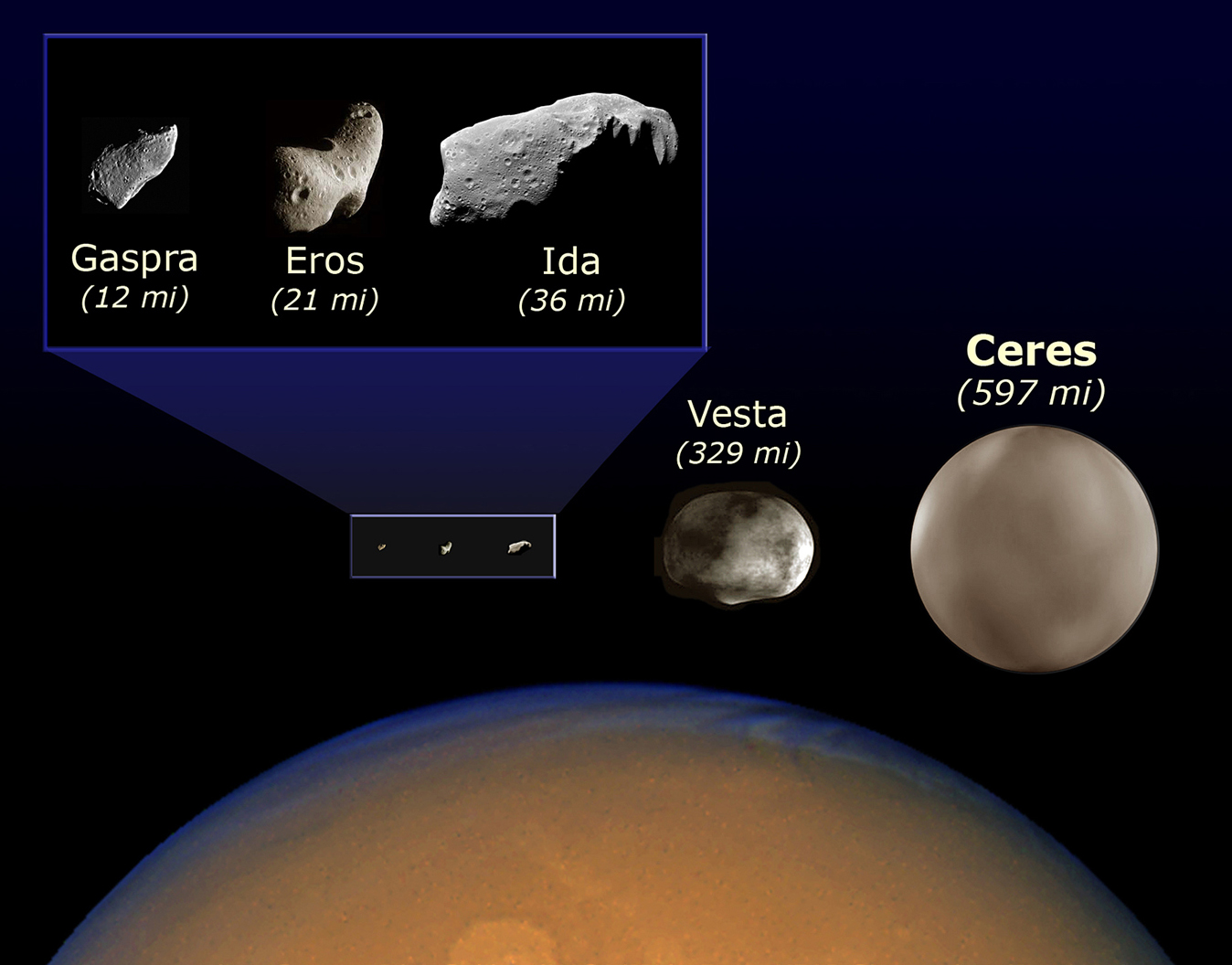
One other persistent myth is that there's enough mass out there to make a good-sized planet, which has been named Phaeton. The reality is that all the asteroids in the belt wouldn't add up to something the size of Pluto, which isn't even considered a planet any more.

But that doesn't mean the asteroids aren't valuable. As tiny planet-like objects, some of them will have a lot of useful minerals, like iron and titanium. Some will have oxygen or water. Most will be almost worthless piles of dirt and dust, but there's a good chance of finding a few that will pay for the trouble of going up there.

Ceres, the largest of the asteroids, is now considered to be a dwarf planet, just like Pluto now is. There are quite a few of these dwarf planets in our solar system, and Ceres isn't the largest, but it's the closest to us, and it's likely to be the most important object in that area. Because it's so big, it's very likely to have a lot of good minerals to recover.

As a dwarf planet, Ceres is so large that it has enough gravity to be roughly spherical in shape, but not enough to clear out its orbit of most other debris, and so form Phaeton.

One more thing about asteroids: there are a lot more of them than the ones in the asteroid belt between Mars and Jupiter. They're all over the Solar system, and many of them orbit near Earth. In fact, many of them cross Earth's orbit every year, and one of them might crash into us in a few years. Many are discovered right after passing close by - some closer than the moon is to us. Should one of these impact the Earth, it would be a very bad day, and no one would see it coming.

I don't know about you, but I'd like it if someone started actively scanning the heavens for all the asteroids that could impact the Earth. Despite what some of the movies would have you believe, there is no such effort, and a bad day can happen with zero warning right now. If you think this is important, start bugging your congress-critter to do something useful instead of trying to destroy the country with health care "reform".

Until next time!


_______

Further reading to whet your appetite for knowledge:
Solar System - Sun
To Your Health - Part 4
Solar System - Mars

.

Thursday, January 7, 2010

Solar System - Mars

.

Things you don't know about the Solar System

I've always found space fascinating, and among my first books was a book about astronomy. It was just a small, general guide that had a number of interesting facts about the solar system and the stars and galaxies. This was 1980 or before, and we've made a LOT of discoveries since then, and I've kept up on it, partly thanks to Ars Technica, the Science Channel, and NASA.

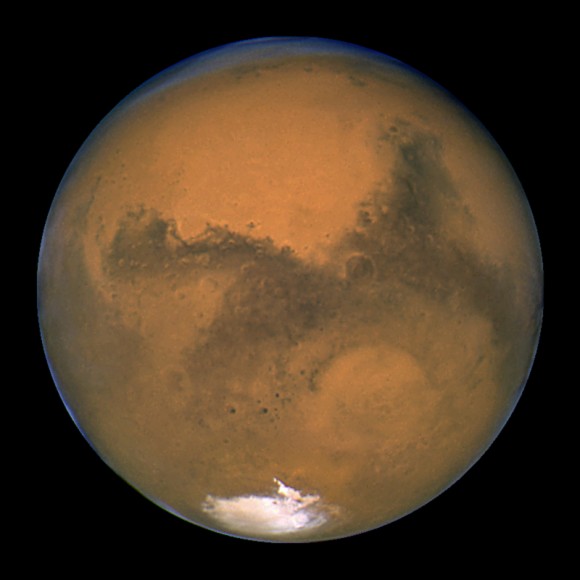
Today's topic: the Red Planet, Mars.


Named for the Roman god of war, Mars may be the next Solar system body that humans set foot on. A few years back, the Bush administration, otherwise known for its hard stance against science, announced the race to Mars. Assuming the world doesn't end in 2012 or 2036, humans should be setting foot on Mars by 2030AD or close to that. And what do you think we're going to find there?

It wouldn't be too hard to tell you something you might not know about Mars that comes from recent news releases. We've got some rovers and probes exploring the planet, and they make discoveries almost every day. As of this writing, the debate still rages whether or not there is or was life on Mars, and whether or how much water is on Mars, but one thing is definitely clear: it had water in its ancient past, and so there may have been microbial life.

But I'm going to tell you something that you can't find hardly anywhere, and certainly not in the news: the Martian atmosphere is a natural laser.

Yep, you heard right! It's a laser.

Laser, as I'm sure all of you know, is an acronym for Light Amplification by Stimulated Emission of Radiation, and it's so commonly used nowadays that it's become a word in its own right.

The Mars laser was discovered back in 1981 (according to this article, which also mentions that Venus' atmosphere is a natural laser too, so hey, I learned something new today too) and since then, it's been one of those little-known facts. The article I linked explains how the lasers work, so I won't repeat them.

Something else you might not know about Mars is that it has two moons. They're both really small, more like captured asteroids, though we haven't studied them well enough to know that for sure yet. The neat thing is that one of them orbits so fast that it crosses the Martian sky twice in a day. This is the moon Phobos, and it's the larger of the two. It's so fast, it travels from west to east! The smaller one, Deimos, is further out and behaves more like a moon should, except that it's so small, it's hard to see.

In about 10 million years, Phobos could crash into Mars, assuming we don't do something about it, though it will probably be torn apart and become a ring a couple million years before that. Deimos, like our own moon, is eventually going to escape its parent planet.

If you missed the start of this series, you can use the links to the left and select the SPACE tag to show you all the space-oriented postings I've done. Our tour starts at the Sun and proceeds outward.

Next time, I'll move outward again and learn you something else you don't know about our solar system. Until then, keep reaching for the sky!

_______

Further reading to whet your appetite for knowledge:
Solar System - Asteroids
To Your Health - Part 3
Solar System - Earth

.

Saturday, December 19, 2009

Solar System - Earth

.

Things you don't know about the Solar System

I've always found space fascinating, and among my first books was a book about astronomy. It was just a small, general guide that had a number of interesting facts about the solar system and the stars and galaxies. This was 1980 or before, and we've made a LOT of discoveries since then, and I've kept up on it, partly thanks to Ars Technica, the Science Channel, and NASA.

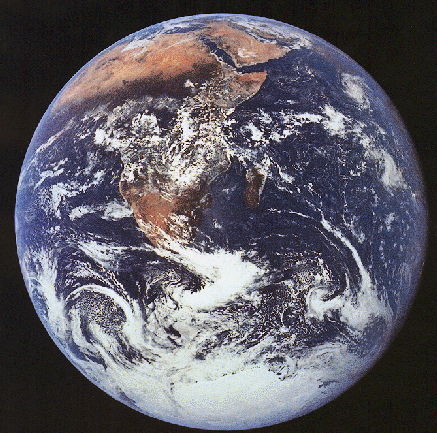
Today's topic: the third rock from the Sun, known to the locals as Earth.

There's a lot about the Earth you don't know. I could fill the entire internet with that kind of thing, and in fact, lots of people are doing just that. So instead of me giving you a list of interesting physical facts about the place you live, I thought I'd share with you an essay I wrote many years ago for school, to help human minds grasp just how enormous the universe is. Enjoy!

We are Tiny

We are tiny. The world we live in is huge. We don’t really grasp how small we are, because we can see maps of the whole world, and we can travel to the other side of it in the space of a few hours or days. We can drive a mile in a minute or less, we can fly a mile in a few seconds, we have spacecraft that can travel a few miles in 1 second, but what if you had to walk? It takes about a third of an hour to walk a mile. Not a whole lot of time in the scale of our lives, but we get tired of it after only a few miles. It would take about two years to walk all the way around the Earth.
There are a lot of things on the Earth that you have never seen before, and may have read about in books, but what about if you hadn’t had those books? You would think these things mostly tall tales, told to amuse children, or the boastings of drunks. It would take too much time and money to go traveling. Something like Disneyland would be a life’s aspiration rather than one choice among many.
The Solar system today is much like the Earth of just 100 years ago. Sure, spacecraft can fly several miles in a second, but with the number of miles to travel, we may as well be walking. It takes days just to reach our nearest celestial neighbor: the moon. It takes months or years to reach the world we are most likely to colonize next: Mars. It would take centuries or millennia to reach the closest visible star: Alpha Centauri. This is a journey the likes of which no one has ever experienced, and no one can really imagine it.
Our knowledge is growing. As we before could not imagine traveling to the ends of the Earth in a mere day, one day we may be able to go much faster than we do now. But even if we are able to instantaneously reach the speed of light itself, the nearest star is still over 4 years away, a journey even Magellan and Drake did not know, and there will be no stops along the way to reprovision or let the crew out to relax and blow off steam.
The galaxy is huge. At the speed of light, it would take about 100,000 years to cross it. This is a journey so huge the mind cannot hope to comprehend it. Along the way, you would see strange things that you didn’t think were possible, and people you tell your stories to would not believe you.
Let us suppose it is possible to build a warp drive, capable of traveling 1000 times the speed of light. A journey to Alpha Centauri would take only a day and a half; still a long time by today’s standards, and no reason to commute to work; it would be equivalent to a long train ride, from one side of a continent to the other. The galaxy-spanning trip still requires 100 years to accomplish.
So let us build a warp drive that travels a million times the speed of light. It now takes about 5 weeks to cross the galaxy; an hour’s travel will carry you over 26 lightyears away; there are an awful lot of visible stars within that range, and quite a few more that we don’t yet know about.
But even at this incredible speed, to reach our galactic neighbor Andromeda would still take 225 years! If we bump up to a billion times the speed of light, the trip takes less than 3 months, meaning intergalactic colonization becomes possible, and we can commute to any place in our own galaxy. It would take only 10-20 years to reach the edge of the universe itself*, a trip so important that you know some one will attempt it.
But until that time, when we can travel almost instantly to almost anywhere, we must remember that the world is a big place. The local group of the closest stars is a big place. The galaxy is a big place, and it will take a long time for it to become small. Until it does, think of space travel as what travel was like before mass production of the automobile: not very fast.

* Recently (2009), I have learned that the most current estimate for the age of the universe is 13.7 billion years, HOWEVER, the universe has been expanding considerably in all that time such that it is approximately 39 billion lightyears to reach the edge of the VISIBLE universe, and the ACTUAL edge may be another billion or two further out. Still, a journey that lasts less than 100 years (there and back) to discover something so important is almost certain to be attempted.
_______


Further reading to whet your appetite for knowledge:
Solar System - Mars
Hey baby, what's your sign? (Updated!)
Solar System - Venus
.

Sunday, November 22, 2009

Hey baby, what's your sign? (Updated!)

.

Astrology. Anyone grounded in the real world shudders at the absurdity of it, and yet, women eat that stuff up as if it really means something. I understand why, of course: it's the childish desire to shed all responsibility for oneself, to put the blame of failed relationships on someone else instead of taking responsibility for ALL your actions (conscious and unconscious), and what better scapegoat than something that doesn't care? It's unfortunate that we as a society encourage this kind of destructive and self-destructive behavior, rather than insisting that people act like adults. Some do, but not the majority.

But I'm not here to rant about society, I'm here to tell you that the sign you think you are is probably not true! (Okay, I'm doing this article because I haven't had time to find something really neat about the physical Earth that most people don't know, but I suppose this will do just fine, since the reason your sign isn't the one you think it is is because of Mother Earth not doing what the ancients thought she was doing. (And ain't that just like a woman?))


You've read in the newspaper or on the internet your daily horoscope. Probably every social-networking and dating site will tell you what your sign is when you tell it your birthday. But these sources of information are flat-out lying to you about 90% of the time.

The 12 signs of the Zodiac are all constellations in the sky. Aries, Taurus, Gemini, Cancer, Leo, Virgo, Libra, Scorpio, Sagittarius, Capricorn, Aquarius, and Pisces. When the Sun is in a particular constellation, and you are born that day, that's your sign. The astrologers would have you believe that these 12 constellations are divided equally in the sky, but in truth, they're not. Some signs have the Sun in them for only 8 days, some for as long as 44 days. And on top of that, there's a 13th sign the Sun travels through: Serpentarius, also known as Ophiuchus. It's nestled between Scorpio and Sagittarius, and lasts 18 days. That's more than twice as long as Scorpio!

It gets worse.

Way back when astrology was first getting started, oh, say around 2600 years ago in 600 BC, we had a different North Star. You have probably heard that the North Pole, over the course of 26,000 years, makes a complete circle as it points to different parts of the sky. So the path the Sun takes through the sky has changed since the Zodiac was made. It goes through the same constellations, but with varying amounts of time. Give a day here, take one away there.

It gets worse.

The Earth's orbit around the Sun is not a perfect circle. There are times it's closer and times it's farther. When it's closer, it travels faster and when it's farther, it travels slower. You learned this when I talked about Mercury's double sunrises a few months ago. Earth does the same thing, but not as dramatically as Mercury, because it rotates faster and is a lot farther out. But, this imperfection in the orbit, and some other complicated math I won't bore you with, means that as the Earth goes around the Sun, the point in space where it is closest to the Sun is also going around. Essentially, if a year was measured from the point that Earth was closest to the Sun instead of when the Sun was in a certain part of the sky, the year would be slightly longer.

Because of this slightly longer "year", known as a precession, it means that over the course of centuries, even decades, on a given day of the year, the Sun might not be in the same constellation it was 10-100 years ago. Now multiply this out by the 2600 years since astrology was codified. What we have is a shift of a little over a month! If this was the only thing wrong, everyone would be off by 1 sign, with about 10% of people off by 2 signs, but because the constellations are different sizes, there are still a few people who have the correct sign.

It gets worse.

The positions of the planets are also of importance to your chart. But the planets wander through more than 13 constellations, they wander through 21 of them! (25 if you count Pluto.) 21 constellations!

It gets worse.

There are a lot of different cultures around the world, and just as not everyone marks their years as 365.25 days apiece - some mark it 365, some alternate between 354 and 384, etc - each has their own constellations and their own astrology. For instance, the Chinese zodiac has 12 different signs, but that's not 12 signs per year, that's 1 year per sign! On top of that, the day you're born in China, you're already considered to be a year old.

Even if we just stuck with the "Western" zodiac, which has been altered many times to take into account newly discovered planets (of which the ancients apparently never noticed their effects or they would have been in the original charts), there's still the problem that no two astrologers will interpret a given chart the same way.

Here's a site that has a lot of the above information. And here's another one.

Okay, so you're already pretty much right-minded or you wouldn't be reading this site, nor would I want you as one of my fans if you weren't, but you've probably got some friend who believes in this stuff, or some girl you want to impress and she believes it. What can you do to set those people straight?

I guarantee you that trying to argue with them won't do it. Not even showing them this article - though I am obviously above reproach in all matters. The harder you try, the stronger they believe. No, you can't do that any more than you can explain to the girl you lust for that you'll be good for her within the first minute of meeting her. Here are the choices I see:

1. Let it go. Be the bigger man (or woman) and let that person have their fun. As long as the person isn't harming anyone, or devoting their life to it, it doesn't matter.

2. Get a better class of friend/girlfriend/boyfriend. Really, if it bothers you enough that you want to beat sense into them, then they're obviously not the kind of friend you need in your life. Or it could be that you're too judgmental. See option 1.

3. Learn a little about it so you can be a fake astrologer too! Hey, chicks dig it! Any that believe in it are likely to believe you're a great guy, too, so you might as well use it to your advantage. For some people, it's a moral obligation to part money from suckers.

4. Spend a great deal of time setting up the frame of reference that you're going to do a scientific experiment, then an even greater deal of time taking that person to a number of astrologers to have their chart done, with the agreement that if the charts are not identical, or if they contradict each other in even the slightest, then all of astrology must therefore be fake.

See, the problem lies in the fact that if someone can believe in something so obviously untrue, they must be brain-damaged. You cannot use logical arguments on someone who doesn't understand logic! You may as well argue that the sun looks wet and tastes like a taco today, but tomorrow it'll be different because then it'll look wet and taste like a taco.

Really, those are your only choices.

Okay, so in the theme of "Here's your sign", I've found a few random things related to signs for you to buy if you want to. Remember that anything you buy through these links helps keep this site running and improving.


_______

Further articles that may interest or help you:
Webster's Rejects
You Might not Know how to Drive
Good Thing these People aren't in Charge of our Economy

.

Thursday, October 22, 2009

Space Links

.

Over the past few months, I've unveiled a few facts about the Solar system you don't know and might not be able to find from casual looking. This month, I want to give you some resources to look up some of this stuff, and to answer the questions that I'm intentionally not answering for you. There's a lot of cool stuff to know.

Did you know that it was because of studying Venus that we discovered the possibility of a runaway Greenhouse Effect? Did you know that the Sun has recently started doing some really strange things? Did you know that, even though the universe is about 14 billion years old, and that nothing can travel faster than light, it's 93 billion light-years across?


The Solar System is filled with fascinating and mysterious objects. Studying Venus was our first clue that a runaway greenhouse effect was possible, and is merely one tiny example of how studying our local space environment can help improve the quality of life on Earth. There’s lots more we need to know, not the least of which is WHEN (not IF) another huge rock is going to hit our planet. Earth is the biggest solid object in the Solar System, and as such, it gets hit far more often than smaller planets, and I think we can all see that the Moon has been hit quite a bit, with its giant craters, so it’s a good idea to find all the rocks that might hit us and get them moved out of our way. As cool as it would be to find aliens with the SETI project, I think this is a little more important.

In the past few years, we’ve built some very interesting telescopes that have allowed us to finally see planets revolving around other stars. We are finding them all over the place, with new ones being spotted literally every day.

We’ve spotted gigantic stars that are so huge they could engulf our Sun and all 9 planets. We’ve spotted star-sized diamonds. We’ve seen galaxies explode. We’ve seen objects traveling very nearly the speed of light. We’ve discovered gigantic black holes, and one of them is at the center of our own galaxy! We’re even peering back to the very beginnings of Time and the Universe themselves, and we’ve got a pretty good picture of how and when the Universe was born and how it’s going to die.

Astronomy is the biggest science, it has provided us with inventions like Velcro, scratch-resistant lenses, CCDs, and satellite protections against the Sun, and it receives very little funding for the myriad of benefits derived from its study. Here is a small list of some of NASA’s contributions to life on Earth.
With all the cool stuff that’s out there to explore, and all the useful stuff we’ve learned already, I don’t know why everyone isn’t trying to be an astronomer!

I’ll be adding more content here as I find interesting things that aren’t widely known; that’s what I’m all about: doing things no one or hardly anyone does. Those of you who want to know more incredible facts about our solar system, our galaxy, and our universe, would be well advised to visit these sites:

Wikipedia has lots of interesting articles, just do a search for the planet or star in question. Frex:
             Pistol Star
             What a black hole is
             What stars are
             The Pillars of Creation
             Mars
          Size of the Universe

This is just a SMALL sample of the awesomeness out there available for your discovery. And if you get the Science Channel, they often have astronomy-related programs to watch.

Oh, and if you want to feel small, watch this video.

_______


Further reading to whet your appetite for knowledge:
Solar System - Sun
Hey baby, what's your sign? (Updated!)
Solar System - Earth

.

Tuesday, September 22, 2009

Solar System - Venus

.

Things you don't know about the Solar System

I've always found space fascinating, and among my first books was a book about astronomy. It was just a small, general guide that had a number of interesting facts about the solar system and the stars and galaxies. This was 1980 or before, and we've made a LOT of discoveries since then, and I've kept up on it, partly thanks to Ars Technica, the Science Channel, and NASA.

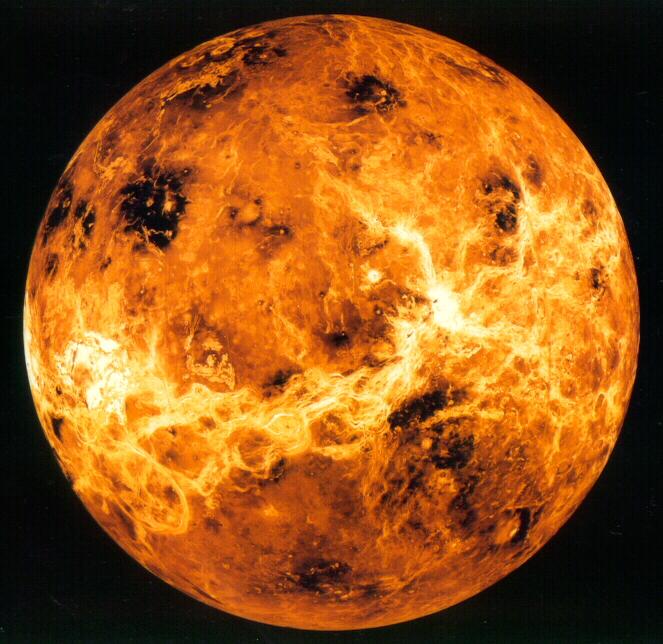
I'm going to present a few curious things to you about what surrounds you that I'll bet you don't know. It's time to discover the hottest planet: Venus.

Known in ancient times as both the Morning Star and the Evening Star, Venus is one of the brightest objects in the sky. When Galileo turned his telescope upon it, he discovered that it went through phases, just like the Moon. It does this because it's closer to the Sun than we are - Mercury also goes through phases, but the outer planets do not.

Better telescopes revealed that Venus was about the same size as Earth, and that it was covered in clouds. It gained the name of Earth's Twin, or even Sister Planet, because of this. It was believed for a long time that with it being of similar size and with clouds that it was probably like Earth, only warmer. When space probes finally reached it, they discovered it was just about the worst place you could be! The temperature was over 800 degrees - hotter than Mercury even though it's twice as far away from the Sun! - and the atmosphere was crushing - 90 times the pressure of Earth's atmosphere - and it was mostly carbon dioxide, plus the winds were constantly howling at supersonic speeds and the clouds were too thick for much light to get to the surface.

It wasn't until we started turning our radars on the planet that we made an interesting discovery: Venus rotates backwards! Very slowly! They also discovered something else: Venus always points the same face at Earth.

Okay, that's not precisely true; here’s a more accurate statement: When Venus is closest to the Earth, it always points the same face at Earth. Because Venus is so covered in clouds that we can’t ever see the surface, except by bouncing radar signals off it, we didn’t know this until fairly recently.

Some of you may be aware that Venus rotates “backwards”, or “retrograde”. The Earth and most other solar-system bodies, when viewed from above the North Pole, spin counter-clockwise, but Venus spins clockwise instead. The Sun, if it was visible from Venus’ surface, would go from west to east.
Venus needs 225 Earth-days (about 7.5 months) to revolve around the Sun, and 243 Earth-days (usually listed as -243 days to denote that it rotates backwards) (about 8 months) to rotate 360 degrees. Its “day” is a little longer than its “year”.

Because it takes Venus 2/3 of an Earth-year to rotate, and about that long for Venus to go around the Sun, Venus comes closest to Earth in the same part of the sky every 2 Earth-years. In this time, Venus has gone around the Sun 3 times and also had three full “days”. The same side of Venus is always facing toward Earth when the two approach!

Future study of the planet is likely to reveal that this is not a coincidence, but rather that there is probably a concentration of mass on Venus that Earth “grabs onto”, in much the same way as the near-side of the Moon is heavier than the far side. Over billions of years, Earth’s gravity grabbed hold of these mass concentrations and caused both Venus and the Moon to always face this way on a regular basis. Chances are good that in its past, Venus rotated much like Earth does, then got hit by something big enough to cause it to slow down enough for Earth to grab hold of it and create this interesting 3-to-2 resonance.

I'm going to tell you one more interesting thing about Venus that you don't know: It's possible to live there without terraforming it. How? I'm glad you asked!

You know that Earth's atmosphere is about 100 miles thick, right? And that the higher you go, the thinner the air is, right? The same is true of other planets. Even though the atmospheric pressure on the surface of Venus is 90 times that of Earth, a few dozen miles above that there is a point where it's a lot closer to Earth-normal pressure. By living in what amounts to giant balloons, we could build floating habitats - not much different from living in ships, which we do all the time here on Earth. The conditions in this band are a lot less hostile. The temperatures are better, and the clouds and storms are at a lower level, so it's calmer too. Plus, it's a lot easier to gather sunlight! It might even rain real water up there!

Okay, that's all I've got from Venus for you. Later!

_______


Further reading to whet your appetite for knowledge:
Solar System - Earth
Solar System - Mercury
To Your Health - Part 2

.

Saturday, September 19, 2009

You Might not Know how to Write in the English Language

.

 
Things you Might not Know


In my travels about the Earth, I have uncovered various truths. It seems there are a lot of people out there who aren’t aware that they don’t know how to drive, or that they don’t know the value of a dollar, or various other Earth-shattering problems. To help regular folks find out if they know this or not, I created some questionnaires so my friends and fans could find out if they are afflicted with these dangerous or inconvenient problems. We’re all often blind to our own problems, right? So take these tests to find out yours.

You Might not Know how to Write in the English Language

1. Have you ever used “should of”, “could of”, or “would of” when you meant “should’ve”, “could’ve”, or “would’ve”? (Double points for this question.)
2. Do you refuse to use any sort of punctuation, so that your readers have to guess where sentences begin and end?
3. Are you a stranger to lower case letters?
4. Are you a stranger to upper case letters?
5. Do you use apostrophes to denote all your plurals?
6. Do you shun the use of the ENTER key, or perhaps use it for just about every sentence?
7. Have you ever used “quote marks” to denote emphasis, rather than underlining, bolding, or italicizing?
8. Are you unaware that when used in that way, quote marks are being interpreted as Yarights? As in, “No” dumping gets read as “yeah, right, go ahead and dump”.
9. Do you despair that handwritten signs don’t come with spell-checkers?
10. Have you ever misspelled “school” when painting it on a road?
11. Do you not know the difference between your, you’re, and yore?
12. How about to, too, and two?
13. Or accept and except?
14. Or they’re, there, and their?
15. Perhaps affect and effect confuse you?
16. Are you frequently accused of being dyslexic, while ACTUAL dyslexics go unnoticed?
17. Have you ever used the word “literally” as an exclamation rather than to denote that something you were saying actually happened and was not just a clever turn of phrase?
18. Would your English teacher cry if she knew how many times you answered yes to these questions?

Scoring
0             Excellent! You probably know how to write in English.
1-2         Please ask your English teacher to smack you upside the head and then teach you what you slept through the first time.
3+          Please refrain from all written communication without a paid transcriptionist assisting you.

Here's a few language tools to help you out.

Saturday, August 22, 2009

Solar System - Mercury

.

Things you don't know about the Solar System

I've always found space fascinating, and among my first books was a book about astronomy. It was just a small, general guide that had a number of interesting facts about the solar system and the stars and galaxies. This was 1980 or before, and we've made a LOT of discoveries since then, and I've kept up on it, partly thanks to Ars Technica, the Science Channel, and NASA.

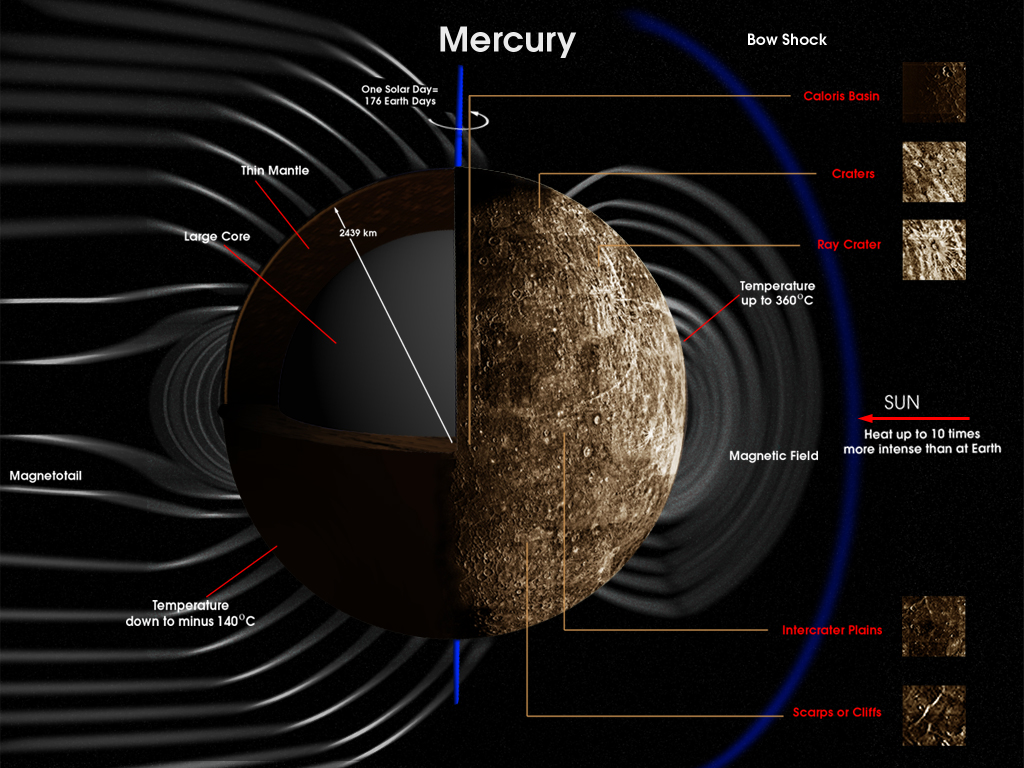
I'm going to present a few curious things to you about what surrounds you that I'll bet you don't know. It's time to discover the planet closest to the Sun and therefore the hardest to observe: Mercury.


Mercury is the fastest planet, swinging around the Sun in just under 3 months. It's so close that it's within the Sun's warped space. For a long time, people thought there was an even-closer planet that was perturbing Mercury's orbit, a truly hellish world they dubbed Vulcan.
However, Vulcan was never discovered, because it wasn't there to be found, yet Mercury's orbit was still not conforming to Newton's predictions. Something else was going on. It wasn't until Einstein's Theory of Relativity that the answer was found.

You've heard that a circle is 360 degrees around, right? Well, massive objects like the Sun distort the space around them. Close to the Sun, where Mercury is, a complete circle is slightly less than 360 degrees, and as a result, Newton couldn't predict where Mercury would be.

Here's something else you don't know about Mercury: it experiences a double sunrise and a double sunset every day. How? This will only take a moment to explain.

Mercury is a big rock, much like the Moon, except it’s really hot because it’s so close to the Sun. The Earth’s distance to the Sun, the famous 93 million miles, has a much easier name to remember, called the AU, which means Astronomical Unit. Earth is 1 AU from the Sun. Mercury is about 2/5 of this distance, and as a consequence, it zooms around the Sun in only 88 Earth-days, which is just under 3 months.

Mercury rotates very slowly compared to Earth. The Earth rotates in 24 hours - one day - but Mercury needs about 59 Earth-days to turn a full 360 degrees. This means a Mercury-day is very long, about 2 months.

Did you notice something there? Its day is 2 months and its year is 3 months? That means that Mercury has 3 “days” for every 2 “years”. Those are incredibly long days!

One other thing you need to know: in its travels around the Sun, Mercury’s orbit is not a perfect circle. Sometimes it’s closer to the Sun than normal, and sometimes it’s farther away. When it’s closer, it goes faster, and when it’s farther, it goes slower. This makes its orbit somewhat elliptical.

You’re already aware that the Moon always keeps the same side facing the Earth, right? This is because the Moon’s “day” is equal to it’s “year”. However, because the Moon also doesn’t have a perfectly circular orbit, this means that sometimes the Moon goes faster and sometimes it goes slower, and because of this, it’s possible to see more than 50% of the Moon’s surface from Earth over the course of a year. Here’s a page and animation I found that explains and shows this wobble...


When Mercury rotates, the Sun comes up over the horizon very slowly. When it is close to the Sun, its increased orbital speed is fast enough that when seen from the ground, the Sun goes back down! Then when the planet moves farther away from the Sun, it slows down and now the sunrise can continue. The same thing happens in reverse on the other side of the planet with the sunset.

To put it another way, the Sun heads west across the sky, then when Mercury is close to the Sun and outrunning its rotation, the Sun goes east for a while, then when Mercury moves away from the Sun, the Sun heads west again.

And so, Mercury’s double-sunrise and double-sunset are caused by this combination of very slow rotation, very fast revolution around the Sun, and orbiting faster than it can spin for a small part of the local “day”.
It’s important to note that, because of the relationship between its “day” and it’s “year” — it’s a ratio of 3 to 2 known as a resonance — this means that these doubles are visible only from small portions of the planet’s surface, and nowhere else. Anywhere else on the day side, you’ll instead see the Sun going backwards for a little while before it resumes its trek across the sky. This isn’t like a Solar eclipse of the Moon, which can happen pretty much anywhere on Earth in narrow swaths for a given event; if you build your house somewhere on Mercury where you saw a double-sunrise, you’ll always be able to see these double sunrises from your house every other “year”.

I haven’t done the math to see if double-sunrises and double-sunsets can be seen from the same locations, but it seems unlikely.

Bonus points for those of you who were also able to figure out that, on certain small locations on the Moon, you can watch the Earth rise and fall over the horizon over the course of a lunar “day” in the same manner!

I think that's enough knowledge to boggle your mind about Mercury. Next up: Venus.

_______

Further reading to whet your appetite for knowledge:
Solar System - Venus
Solar System - Sun
To Your Health - Part 1

.

You're Wondering what this Place is all About

Do us a Small Favor, Please:

Terms of Use - legally binding; sadly necessary